The Hidden Math of Fleet Management in Qatar
Most fleet managers focus on the sticker price — but the real question is how much a vehicle costs to own. Master TCO, forecast residual value, and pinpoint the exact moment to replace your assets for maximum profitability.
Let our experts run the ‘40% Rule’ on 3 of your vehicles — and show you exactly where your fleet is losing money.

Your Purchase Price Is Only the Beginning
For a typical commercial vehicle operating in Qatar, ongoing expenses — fuel, maintenance, insurance, registration, and downtime — routinely exceed the monthly finance or lease installment by a factor of two to three times. Yet most fleet decisions are still made based on acquisition cost alone.
To build a truly profitable fleet, managers must transition from reactive bookkeeping to predictive financial modeling. At the core of this strategy is mastering the Total Cost of Ownership (TCO) — the only framework that accurately forecasts residual value and mathematically identifies the most profitable moment to cycle a vehicle out of your fleet.
The Real Cost Reality
For every QAR 1,000 you spend on a monthly vehicle payment, you may be spending an additional QAR 2,000–3,000 on operating costs you haven’t fully accounted for.
- Fuel and routing inefficiencies
- Unplanned breakdowns and repairs
- Insurance and registration fees
- Lost revenue from vehicle downtime
Deconstructing Total Cost of Ownership
TCO is the sum of every Qatar Riyal a vehicle takes from you during its entire lifecycle. The fundamental formula is:
Fixed (Ownership) Costs
Predictable baseline costs including vehicle acquisition or lease payments, insurance premiums, Istimara (vehicle registration) fees, and depreciation. Depreciation is the single largest cost in any vehicle's TCO.
Variable (Operating) Costs
Fluid expenses that fluctuate with fleet usage: fuel, periodic and corrective maintenance, emergency repairs, Darb tolls and road fees, and traffic fines (Mukhalafat). Fuel typically accounts for 21% to over 40% of total vehicle operating costs.
Cost of Downtime
One of the most expensive hidden metrics in Qatari fleet operations. Every hour a commercial vehicle sits idle can cost hundreds of QAR in lost revenue, driver standby pay, and emergency repair premiums.
Breaking Down the TCO Formula for Qatar Fleets
What Goes Into Your Cost Calculation
Accurate TCO requires aggregating every cost category across the vehicle’s full lifecycle — from the moment of purchase through final resale in Qatar’s secondary vehicle market. Many fleet managers in Qatar underestimate variable costs because fuel, maintenance, and fines are tracked across separate systems.
Integrating all data into a single TCO model — ideally through a fleet management platform — gives finance analysts a true picture of asset profitability.
| Cost Category | % of Total TCO |
|---|---|
| Depreciation | 30–40% |
| Fuel | 21–40% |
| Maintenance & Repairs | 10–20% |
| Insurance & Registration | 5–10% |
| Downtime & Lost Revenue | 5–15% |
Note: Percentages represent independent ranges per category — total TCO is the sum of all categories combined.
Forecasting Residual Value Like a Pro
Residual value is the estimated worth of your vehicle at the end of its useful life or lease term — what remains after the asset has passed through depreciation. In Qatar’s dynamic used-vehicle market, accurately forecasting this number is critical: it dictates your depreciation expense and heavily influences whether you should buy or lease.
Why Human Intuition Fails at Predicting Residual Value in Qatar
Studies indicate that manual residual value forecasts in dynamic markets like Qatar can have an error margin of up to 25%, costing fleets tens of thousands of QAR per vehicle.
Qatar’s used-vehicle market is volatile and thinly documented, lacking the standardized valuation guides common in Western markets. The sheer number of variables — brand, mileage, condition, market timing, GCC demand cycles, and regulatory shifts — overwhelms human capacity for simultaneous tracking.
Fleet managers often rely on gut feeling, singular dealer quotes, or outdated depreciation tables. These methods introduce significant forecasting errors, turning what should be a calculated asset cycle into a financial gamble. A single misjudged residual value can distort entire lease vs. buy decisions and inflate TCO considerably.
This is exactly the gap that AI-powered valuation tools are designed to close.
AI Tools Are Transforming Fleet Valuation in Qatar
What AI Valuation Tools Analyze
- Engine size and vehicle specification
- Vehicle age and accumulated mileage
- Real-time GCC used-vehicle market pricing
- Historical depreciation curves by model
- Telematics data: idle time, harsh braking, engine faults
- Seasonal demand patterns in Qatar’s market
From Guesswork to Precision
Predicting residual value is no longer a guessing game. Advanced algorithmic pricing tools using machine learning models — such as Random Forest and XGBoost — deliver objective fair market valuations in seconds, processing thousands of real-time data points from Qatar and broader GCC markets.
Fleet managers using AI valuation tools on platforms like vehicletracking.qa can track exactly how each asset is depreciating in real time, enabling smarter buy/sell/lease decisions backed by data rather than intuition.
Try our valuation tool: Vehicle Valuator Qatar.
Finding the Sweet Spot: The Most Profitable Time to Replace
Vehicle operational life refers to the precise length of time — or kilometre threshold — an asset should remain in your Qatar fleet before its accumulated costs outweigh its benefits. Two opposing cost curves determine this sweet spot.
Ownership Costs Decrease Over Time
As the vehicle depreciates, your annual ownership cost per kilometre falls. The asset is "paying off" its initial purchase price over time, making early-year ownership expensive on a per-unit basis.
Operating Costs Increase Exponentially
Maintenance and repair costs are low when the vehicle is new but increase rapidly as the vehicle ages, parts wear out, and breakdowns become more frequent — especially under Qatar's demanding climate conditions.
The Optimal Replacement Point
The most profitable replacement point occurs at the lowest point on the Total Cost Curve — where ownership and operating costs combined are at their minimum. Holding a vehicle beyond this point costs you money daily.
The 40% Rule: Qatar’s Most Actionable Fleet Benchmark
The Replacement Trigger Rule
Flag a vehicle for replacement when its annual maintenance cost exceeds 40% of its annual depreciation.
Why This Benchmark Matters for Qatar Fleets
If you wait until operating costs surpass this threshold, the premium you pay for emergency repairs and vehicle downtime will completely erase any savings gained by holding onto the older asset. In Qatar’s extreme heat — which accelerates wear on tyres, cooling systems, and engines — vehicles hit this threshold faster than in temperate climates.
Applying this rule systematically allows your finance team to build rolling replacement schedules tied to actual cost performance, rather than arbitrary kilometre or year limits. This is the difference between reactive fleet management and a proactive financial strategy.
Vehicles operated beyond the 40% threshold in Qatar’s climate can see emergency repair costs escalate by 3–5x versus planned maintenance.
Four Strategies to Lower TCO and Protect Residual Value

Shift to AI Predictive Maintenance
Reactive maintenance — fixing it when it breaks — is the most expensive strategy, with emergency roadside breakdowns averaging QAR 17,500 per event. AI predictive maintenance analyzes telematics data, fault codes, and engine temperatures to forecast component failures 7 to 14 days in advance, converting emergencies into planned interventions costing under QAR 3,300.
Utilize Telematics for Fuel & Routing
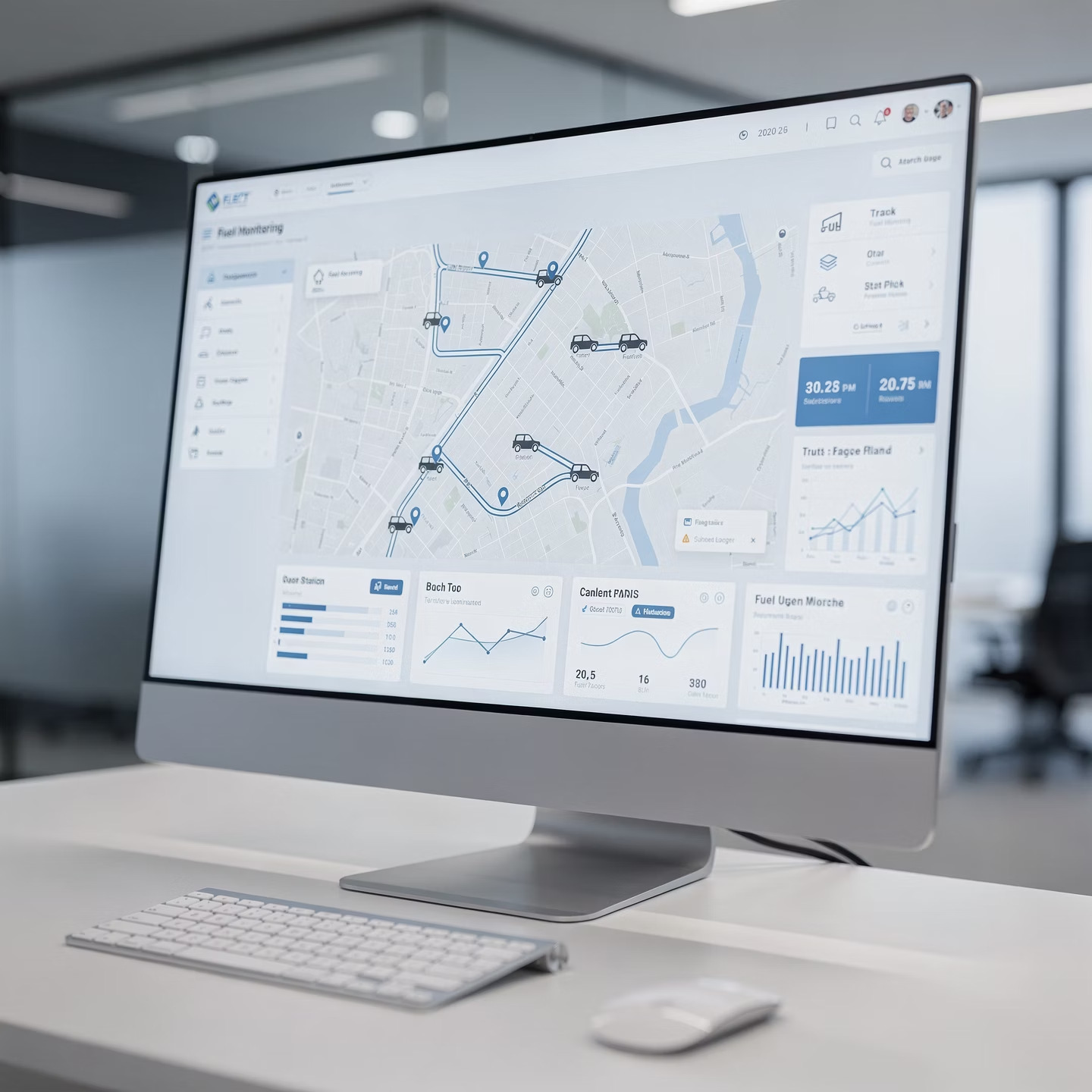
Integrating telematics with fuel cards enables automatic calculation of accurate Kilometres Per Litre (KPL) and Cost Per Kilometre (CPK) metrics. Monitoring and reducing idle time — a significant issue in Qatar's stop-and-go traffic and on-site operations — can save thousands of QAR per vehicle annually in wasted fuel.

Optimize Your Lease Structure
A closed-end (operating) lease transfers depreciation risk to the lessor — ideal for predictable cash flows and standard mileage fleets. An open-end (finance) lease is better suited for specialized upfits or high-mileage operations common in Qatar's construction and energy sectors, though it requires active residual value management.

Enforce Preventive Maintenance Compliance
A PM compliance rate above 94% dramatically reduces mean time to repair (MTTR) and unplanned downtime. Meticulous maintenance documentation also guarantees buyer confidence when the vehicle enters Qatar's secondary market, maximizing your financial return at disposal.
The Numbers That Define Fleet Financial Performance
Replacement Trigger
Flag a vehicle when annual maintenance exceeds 40% of annual depreciation
Avg. Emergency Breakdown
Cost per unplanned roadside breakdown event in commercial fleet operations
PM Compliance Target
Preventive maintenance compliance rate that dramatically reduces downtime
AI Failure Forecast Window
How far in advance AI tools predict component failures from telematics data
Download & Share These Assets
All visuals from this guide are free to download and use on your website, social media, or internal fleet reports. Click any image below or use the download link to save it.

Stop Treating Vehicles as Expenses — Start Managing Them as Assets
By mastering your TCO calculations and leveraging modern AI-driven insights available through vehicletracking.qa, you stop viewing your fleet vehicles merely as cost centers and start managing them as dynamic financial assets. Every kilometre driven should contribute to your bottom line — not erode it.
Whether you manage 5 vehicles or 500, the principles of TCO modeling, residual value forecasting, and data-driven replacement scheduling apply equally.