Know What Your Vehicles Are Really Worth
AI-powered vehicle valuation transforms guesswork into precision — giving fleet managers, dealers, insurers, and finance teams the accurate asset intelligence they need to make smarter, more profitable decisions.

The Hidden Cost of Not Knowing Your Asset’s Value
Every vehicle you own — whether a single company car or a fleet of hundreds — is a depreciating asset sitting on your balance sheet. Without accurate, current valuation, that asset is a financial blind spot. You may be over-insuring or under-insuring. You may be holding onto vehicles past their optimal replacement window, bleeding maintenance costs. You may be approving loans against inflated collateral, or selling trade-ins below market value.
Vehicle valuation is not just an administrative task. It is a strategic financial function that directly impacts profitability, compliance, and operational efficiency. Organizations that invest in accurate, data-driven valuation consistently outperform those relying on outdated, intuition-based estimates. The question is not whether to valuate your vehicles — it is how accurately you can do it.
The Stakes Are Real
From Manual Checklists to AI Precision
Vehicle valuation has undergone a fundamental transformation. Understanding both approaches helps professionals choose the right tool for every scenario.
Traditional Valuation
- Physical walkarounds with 161–226 point paper checklists
- Market comparison against current listings for similar makes and models
- Straight-Line or Declining Balance depreciation formulas
- Dealer appraisals based on local inventory and specialist experience

AI-Powered Valuation
- Ensemble machine learning models including Random Forest and XGBoost
- Computer vision detecting damage down to 0.2mm precision
- Real-time ingestion of mileage, regional demand, and accident records
- Non-linear depreciation mapping including first-year value drop analysis
How AI Determines True Market Value
Today’s leading AI valuation platforms process thousands of real-time variables simultaneously — something no human appraiser can replicate at scale or speed.
Numerical Data
Engine size alone contributes ~40% to price prediction. Exact mileage via telematics and precise vehicle age are key numerical inputs.
Categorical Data
Brand reputation, model popularity, fuel type, and transmission classification all inform algorithmic pricing with high weighting.
External Factors
Regional demand variations, seasonal market trends, and full historical accident records are dynamically integrated into every valuation.
Visual Inspection AI
Convolutional Neural Networks analyze photos and video to detect microscopic damage, measure tire tread, and inspect underbody conditions.
The GCC-Spec Premium: A Value Driver Unique to This Region
In the Middle East, not all vehicles are equal — even when make, model, year, and mileage match exactly. GCC-specification vehicles are engineered for the region’s extreme heat, dust, and driving conditions, and the market prices them accordingly.
Why GCC-Spec Commands a Premium
- Heavy-duty cooling systems and reinforced engine components designed for temperatures exceeding 50°C
- Full manufacturer warranty support valid across GCC countries
- Corrosion-resistant undercoating and dust-sealed electronics
- Up to 20% higher resale value compared to equivalent imported (non-GCC) spec vehicles
Overpayment Risk on Imports
Buyers and lenders who fail to identify non-GCC spec vehicles risk overpaying by up to 20% against true regional market value.
AI Spec Detection
Advanced AI valuation models automatically detect GCC vs. non-GCC specification from VIN data, build records, and visual inspection — preventing mispricing at source.
Insurance & Warranty Implications
Non-GCC vehicles may carry voided warranties and higher repair costs, factors that must be reflected in both insurance premiums and loan collateral assessments.
Qatar Compliance: MOCI Circular No. 1 (2025) & What It Means for Valuation
Qatar’s Ministry of Commerce and Industry (MOCI) Circular No. 1 (2025) mandates that dealers clearly display spare part and maintenance prices. For fleet operators and finance teams, this creates a new compliance layer — and a new opportunity for AI valuation tools that integrate these mandated local price points.
Fleet Managers: Valuation Is Your Most Powerful Cost Control Tool
For fleet operators, vehicle valuation is inseparable from financial performance. Every vehicle in your fleet is depreciating — and the rate at which it does so determines your total cost of ownership, replacement timing, and remarketing profitability. Accurate valuation intelligence transforms reactive maintenance into proactive lifecycle strategy.
The industry’s well-established “40% Rule” states that when a vehicle’s annual maintenance costs exceed 40% of its annual depreciation value, it is no longer a profitable asset. Without an accurate current valuation as your benchmark, applying this rule is impossible. AI-driven valuation gives fleet managers a dynamic, always-current residual value for every unit — enabling smarter buy-vs-lease decisions and optimal remarketing windows.
Decision trigger: retire a vehicle when annual maintenance costs exceed 40% of its annual depreciation value.
Total Cost of Ownership (TCO)
Calculate the true lifetime cost of each asset with depreciation curves built on real market data.
Optimal Replacement Timing
Apply the 40% Rule precisely using real-time valuations to retire vehicles at peak remarketing value.
Lifecycle & Residual Planning
Forecast residual values to determine lease vs. buy strategies and maximize end-of-life proceeds.
Insurers & Adjusters: Eliminate Claims Leakage with Objective Valuation
Finance & Accounting Teams: Valuation Drives Balance Sheet Integrity
Why It Matters for Your Books
Owned vehicles are recorded as fixed assets. Leased vehicles appear as Right-of-Use (ROU) assets and Lease Liabilities under IFRS 16. In both cases, the accuracy of the recorded value has direct implications for financial reporting, compliance, and audit outcomes.
Under IFRS / IAS 36, regular AI-driven valuation is a legal requirement: companies must immediately recognize an impairment loss and write down a vehicle’s book value if it exceeds its current Fair Market Value (FMV). Real-time AI valuation ensures you are never caught off-guard by an impairment event.
Loan Approvals & Collateral
Banks use current valuation data to determine appropriate loan-to-value ratios, reducing exposure on both new and used vehicle financing.
Impairment Testing (IAS 36)
Automated valuation alerts flag when book value exceeds market value, enabling timely impairment recognition before audits expose discrepancies.
Depreciation Accuracy
Replace rigid formula-based depreciation with AI-mapped non-linear curves that reflect actual market behavior, including the critical first-year 20–30% value drop.
Under IAS 36, failure to recognize impairment on time is a reportable audit finding — AI valuation removes that risk entirely.
Dealers & Remarketing: Turn Valuation Into a Competitive Advantage
In automotive retail, margin is won or lost at the trade-in desk and at auction. Dealerships that deploy real-time AI valuation tools have reported sales increases of up to 30% by offering more competitive, transparent, and defensible trade-in prices. Buyers trust numbers they can see justified — and sellers close faster when confidence is high.
Transparent Remarketing
AI-generated condition reports with pricing justification build buyer trust and support premium sale prices at auction and on the lot.
Trade-In Optimization
Real-time market data eliminates the guesswork from trade-in offers, reducing over-allowances and increasing per-unit profitability.
Inventory Positioning
Know exactly where each vehicle sits in the current regional market before pricing it — and move inventory faster with data-backed confidence.
Who Should Be Getting Their Vehicles Valued?
If you own, manage, finance, insure, buy, or sell vehicles — accurate valuation intelligence is not optional. It is foundational to sound financial and operational decision-making.
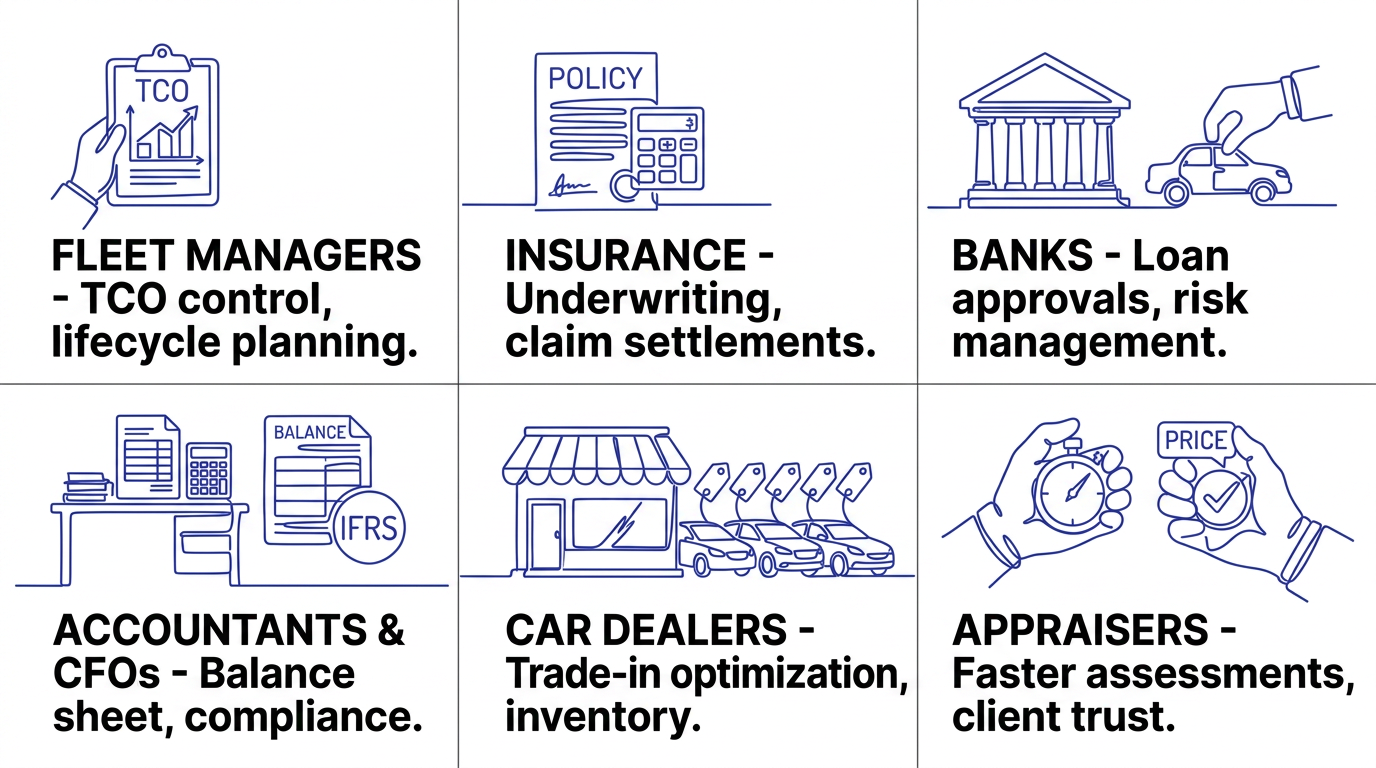
Fleet Managers
TCO control, lifecycle planning.
Insurance
Underwriting, claim settlements.
Banks
Loan approvals, risk management.
Accountants & CFOs
Balance sheet, compliance.
Car Dealers
Trade-in optimization, inventory.
Appraisers
Faster assessments, client trust.
The Valuation Gap: What You Lose Without It
Without Accurate Valuation
- Assets mispriced on balance sheets, creating audit risk
- Vehicles held past optimal replacement, inflating maintenance spend
- Trade-ins priced on gut feel, leaving margin on the table
- Claims settled slowly and expensively due to disputed values
- Loans approved against stale, overvalued collateral
With AI-Powered Valuation
- Real-time fair market values aligned with IFRS and reporting standards
- Data-driven replacement decisions that maximize remarketing returns
- Competitive, transparent trade-in offers that close deals faster
- Claims settled in minutes with 95–97% total loss prediction accuracy
- Loan collateral assessed against live market data for sound risk management

Ready to Know What Your Assets Are Really Worth?
Whether you manage a fleet of 500 vehicles, underwrite automotive insurance policies, maintain corporate balance sheets, or operate a dealership — precise, real-time vehicle valuation gives you the financial intelligence to act with confidence. Stop estimating. Start knowing.
Our AI assistant can analyze your 5 oldest assets against current Qatar market data to reveal whether your balance sheet is accurately reflected — and flag any vehicles past their optimal replacement point under the 40% Rule.